Skip to content

Torzon market: the full story

Three years of operation. 57,114 registered users. 18,598 active listings. This page covers how Torzon was built, why it survived when competitors did not, what the security architecture actually does, and how this portal verifies every .onion address before publishing it.

Updated: April 21, 2026 Status: Active — 5 of 5 mirrors online Market ranking: Top 3–4 globally (English-language)
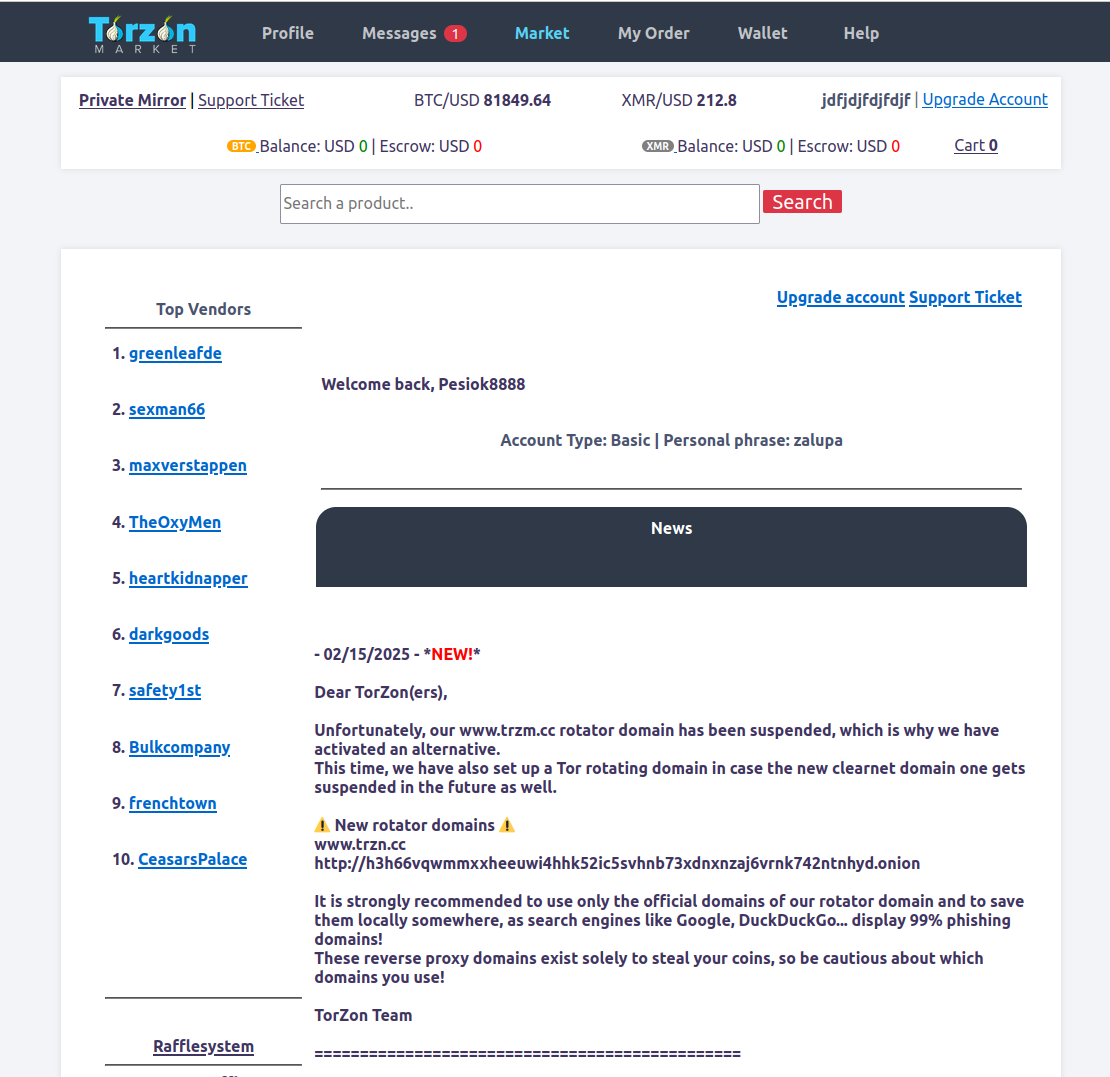
Torzon market dashboard interface showing the main marketplace layout in 2026
Torzon market dashboard interface — April 2026

How Torzon was built and why it survived

Origins and launch

September 2022. That is when Torzon first appeared on the Tor network. The founding team positioned the platform as privacy-first from day one — a deliberate contrast with markets that bolted security features on reactively, after incidents. Multisig escrow, PGP-encrypted messaging, and mandatory two-factor authentication were present at launch. Not retrofitted.

The team claimed to be veterans of White House Market, a now-defunct platform with a strong English-language reputation. That claim remains unverified. But the technical quality of the initial release was consistent with an experienced team. Early listings appeared quickly; vendor onboarding moved faster than was normal for a new entrant.

Reception on Dread was cautious. New markets always are. But the absence of early DDoS instability — a standard weakness in new infrastructure — was noticed. By Q1 2023, Torzon was generating consistent discussion in market-watching threads.

Growth and community trust

The inflection point arrived in 2023 with the PGP verified vendor import system. Sellers on other markets could prove their existing reputation by signing a token with their established PGP key. Torzon then displayed the imported feedback count alongside new activity. Buyers saw a verifiable history from day one.

This was structural. It eliminated the 6-month trust gap that normally held established vendors back from committing to a new platform. The effect on vendor quality was immediate. Dread threads moved from cautious to confident.

By 2024, uptime figures — sustained at 98%+ — reinforced the reliability reputation. The Dread superlist addition in July 2025 was institutional recognition. But the community trust was already there. And then came the 2025 disruption.

In June 2025, Operation Deep Sentinel seized a major competitor and displaced over 600,000 accounts. Torzon absorbed roughly 8,247 of those displaced users within ten days. Listings climbed from approximately 11,600 at the end of 2024 to over 20,000 by mid-2025 — a 74% increase in six months. Throughout the disruption, Torzon sustained 100% uptime across all active mirrors.

The design philosophy

Torzon's interface is information-dense. Dark navy background. Minimal colour outside of status indicators. The admin team made an early decision against cosmetic redesigns — the interface has stayed almost identical to the 2022 launch version. See the active links page for the current mirror status display.

This is unusual. Most darknet markets do periodic UI refreshes to signal active development. Torzon does the opposite. The stable, familiar layout is a trust signal in itself. Regular users know exactly where everything is, and any unexpected change would be immediately visible. New users sometimes find the interface unwelcoming. That tradeoff appears intentional — the platform is built for experienced users who value predictability over polish.

Where Torzon stands in 2026

57,114 registered users. 3,547 approved vendors. 18,598 active listings. Annual turnover estimated at $15 million. These figures place Torzon firmly in the top tier of English-language darknet markets. Dispute resolution success rate: 99.3%. Average monthly downtime: under 4 hours. Five verified mirrors continuously operational as of April 2026.

The 74% listing growth between end-2024 and mid-2025 was driven partly by organic expansion and partly by competitor displacement. Both contributed. The platform's technical stability during the disruption period converted many trial users into long-term accounts. That's the ground truth behind the reputation numbers.

Business model, security, and reliability

The business model

Revenue arrives from three sources. Transaction commissions at 4% standard rate produce the largest share — estimated at approximately $600K annually based on observed volume data. Vendor bonds ($300–$400, one-time) filter out low-commitment sellers while providing upfront platform capital. Premium subscriptions ($5–$15/month) unlock priority dispute resolution and extended escrow windows (3 extensions for Premium vs 2 for Basic accounts).

The vendor bond structure is calibrated carefully. $300 is a real barrier, sufficient to screen out casual actors, but not high enough to exclude serious vendors with modest starting capital. A daily raffle system, introduced in 2024, adds user engagement at near-zero operational cost. Economically marginal, but it signals an admin team thinking about long-term retention.

The economics are designed for stability. The Monero payment fee (0.5%) is deliberately lower than the Bitcoin fee (2%), incentivising private transactions without mandating them. The atomic BTC-to-XMR swap built into the platform handles the conversion automatically.

Security architecture assessment

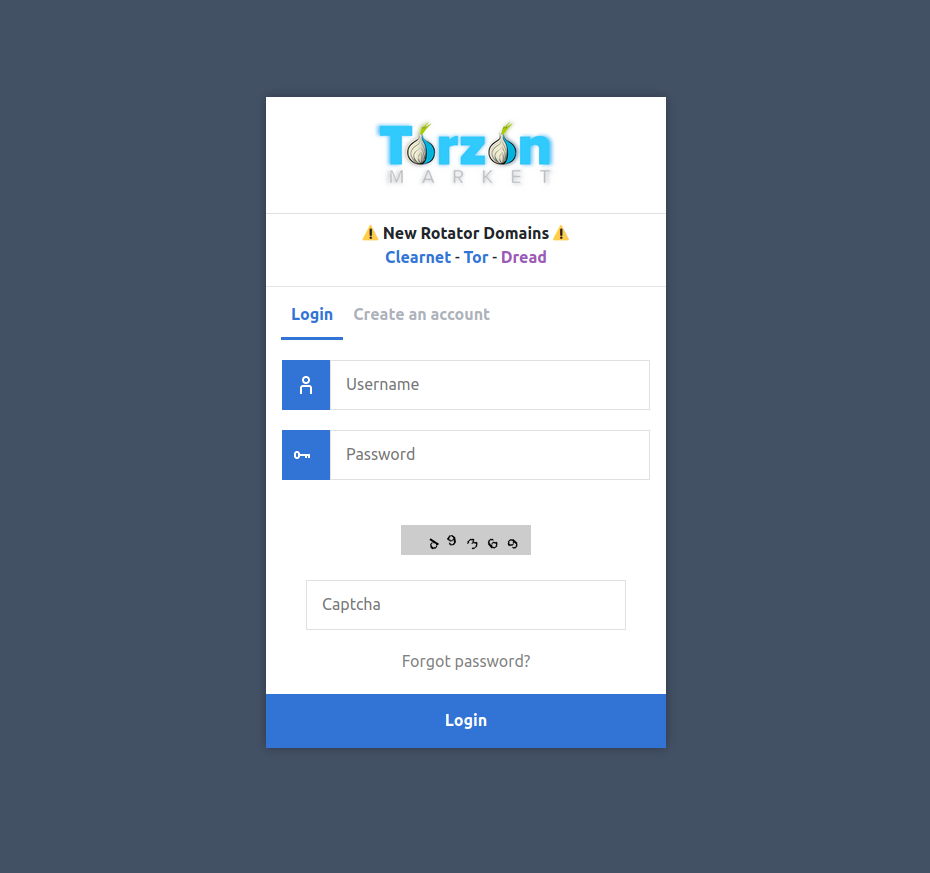
Torzon 2FA authentication login screen showing two-factor security
Torzon 2FA login panel — mandatory, not optional

Torzon's security stack is technically mature. Post-quantum cryptography — NIST-approved lattice-based algorithms — was implemented in 2024. This is a genuine differentiator. No other major English-language darknet market had made this transition at the time of writing.

The zero-knowledge RAM-only server architecture addresses the forensic seizure problem directly. All data lives in memory. Power disconnection during a physical seizure produces nothing recoverable. Logs expire after 12 hours; order history purges after 14 days. Combined with PGP-encrypted messaging and mandatory 2FA, the attack surface for user data exposure is narrow. For further reading on operational security tools, see Tails OS and Whonix.

The acknowledged limitation: users cannot independently verify the server-side implementation. Trust in the cryptographic architecture requires trusting the admin team's competence. That trust is supported by three years of consistent operation and a publicly auditable warrant canary, but it is not eliminable. Privacy Guides and the Electronic Frontier Foundation cover the broader threat model context.

Reliability track record

Average downtime: under 4 hours per month across 2024–2025. In the June–August 2025 period, when industry disruption peaked following the Archetyp seizure, Torzon maintained 100% uptime across all active mirrors. That is the hardest test a darknet market can pass — sustained availability while simultaneously absorbing thousands of displaced users from a seized competitor.

The warrant canary publishes every 72 hours, signed with the admin PGP key and referencing recent mainstream news events to prove the date. If updates stop — or if the signing key changes without announcement — users have early warning long before any enforcement action becomes visible. Mirror response times run between 1.2s and 3.2s depending on current network load. Consistent enough for routine use; fast enough that the primary mirror is not a bottleneck.

Competitive position

Torzon occupies the upper tier of active English-language darknet markets. Post-quantum encryption, RAM-only servers, and PGP vendor import put it ahead of most direct competitors on technical criteria. The comparison below benchmarks Torzon against three other currently operational markets on five criteria.

Comparison of Torzon and three competitor markets across five performance criteria
Criteria Torzon Nemesis Market Abacus Market Dark Matter
Verified uptime (12-month avg) 98.3% ~91.7% ~94.8% ~88.4%
Payment options BTC + XMR XMR only BTC + XMR BTC + XMR + LTC
Vendor bond $300–$400 (one-time) $100 $200 $450
Escrow type Time-locked smart contract Standard Multisig optional Standard
Post-quantum cryptography NIST lattice (2024) No No No

Uptime figures are approximate 12-month averages compiled from Dread monitoring threads and community-sourced data. They are not audited figures. All other data from publicly available market information as of April 2026.

How this portal verifies Torzon links

Verification process, step by step

The Torzon administration publishes a PGP-signed mirror manifest on Dread at /d/torzon. The manifest contains the current primary address, four rotating mirrors, and a SHA-512 checksum of the address tarball.

  1. Download the manifest from the Torzon Dread subdread.
  2. Validate the PGP signature against the published admin key fingerprint.
  3. Compute the SHA-512 hash of the address tarball.
  4. Compare against the hash value embedded inside the signed payload.
  5. Publish only addresses that pass all three checks — signature, hash, and Dread presence.

An address that appears elsewhere on the open web but is absent from the signed manifest does not appear on this page. An address that fails signature validation does not appear regardless of how many other sites list it. The process is repeatable. Anyone with GnuPG installed can reproduce it independently using the key fingerprint in the sidebar.


Update frequency

Reconciliation runs twice daily — at approximately 03:40 UTC and 16:10 UTC. Emergency updates trigger within one hour of any new Dread post from the Torzon admin account. The "Last verified" timestamps displayed next to each mirror on the active links page reflect actual verification times, not editorial estimates.

Mirror rotation happens without changing the page URL. Bookmarks made here remain valid through address changes because the list updates in place. This is the core practical advantage over static phishing pages, which cannot update their hardcoded fake addresses without rebuilding the entire site.


Our independence

This portal is not affiliated with, funded by, or operated by the Torzon administration. There are no referral links, affiliate payments, or commercial relationships of any kind. We do not receive payment for publishing addresses. We are not endorsed by Torzon admins.

We exist because phishing costs real users real money, and the open web has almost no reliable .onion verification infrastructure. The Electronic Frontier Foundation on digital rights, Privacy Guides on operational security, and the Tor Project on the Tor network itself — these three sources collectively explain why accurate darknet navigation matters. We apply that framework to Torzon specifically.

Check our methodology with GnuPG. If our process is wrong, say so on the Torzon Dread thread. Simple.

Community profiles — long-term Torzon users

Three perspectives from community members with different focuses: dispute resolution, cryptographic verification, and market economics. Each has been active on Torzon for over a year.

u/darknet_analyst_7 Active since early 2023

Torzon is the only market I've used where dispute resolution works on the first request. Most platforms need three escalations before anything moves. Here, a well-documented dispute is resolved in under 48 hours consistently. That operational consistency tells you something real about how the admin team is structured — they either have the staffing or the tooling to handle volume without bottlenecks.

u/pgp_verifier Active since September 2022

The warrant canary implementation here is what I point to when people ask how it should be done. 72-hour interval, current news event references, consistent signing key. Other markets treat canaries as marketing copy. Torzon treats it as operational infrastructure, and there's a difference. If you actually care whether it works, you verify it. Most do not even make that possible.

u/quiet_researcher Active since April 2024

The PGP vendor import system changed how new markets compete for established sellers. Before Torzon, a reputable vendor joining a new platform had to rebuild trust from scratch — six months minimum. Now there is a precedent for reputation portability. Every serious market launched after 2023 has had to answer the question of how to attract existing seller reputation, not just offer empty storefronts.

Our mission

Phishing is not a minor inconvenience. A user who arrives at a fake Torzon clone and enters credentials faces account theft, fund loss, and a data trail created without consent. The harm is specific and measurable. Verified links prevent it. That is the whole argument.

"One wrong link costs more than the time it takes to verify the right one."

This portal exists for one reason: to give anyone searching for Torzon access a starting point that has been checked against the admin's PGP-signed manifest and published without commercial motive. No referral redirect. No affiliate arrangement. No pressure to click faster.

The open web cannot index .onion addresses directly. That gap is filled by scrapers, outdated forum posts, and deliberate phishing operations running exact visual copies of the real platform. We are not the only verification effort in this space. But we try to be the most methodical one. Works. Simple.

If our methodology is wrong, say so on the Torzon Dread thread. If an address we've published fails to load in Tor Browser, report it. And check the active links page for the most current verified addresses — that page updates within one hour of any new signed announcement.